
To identify disabled people in a population survey, questionnaire designers use a screening module. The screening module is made up of suitable questions and a threshold. The threshold is based on responses given to the questions by survey respondents. Together, the questions and the threshold, set the criteria for counting a person as disabled in the survey.
Developing a disability screening module is challenging because there is little or no broad agreement nationally or internationally on a definition of what is meant by ‘disabled,’ nor is there a standardised method for identifying the disabled population in surveys. Changes in the understanding of disability and approaches to collecting data about disabled people since the survey was last run in 2006 mean the screening method used previously is no longer fit for purpose. The 2026 IDS pilot will use a new screening method.
The development of the 2026 IDS pilot screening module will begin with screening methods recommended by the UN Washington Group on Disability Statistics (WG). The Washington Group Extended Set on Functioning provided the basis for the adult questions and the Washington Group and UNICEF Child Functioning Module for the child set.
Considerations will be given to the question sets used in the national surveys; Irish Health Survey (aligned to the regulatory European Health Interview Survey), which utilises the Budapest Initiative questions. Additionally, we will consider best practice set by comparative international disability surveys, notably Stats New Zealand’s ‘Household Disability Survey’; Statistics Canada’s ‘Canadian Disability Survey’; and the Australian Statistical Bureau’s ‘Survey on Disability, Ageing and Carers’.
Additions and amendments will be required to the WG questions, based on requirements set by the Steering Group and Sub-groups. Other amendments may come as a result of findings from focus groups or cognitive interviewing, international comparators, survey length constraints, and to better meet stakeholder data needs and the survey’s objectives.
The disability concept being measured in the IDS is functional and is underpinned by the International Classification of Functioning, Disability and Health (ICF). There are different ways of conceptualising disability. Historically, the medical model was the most prominent way of thinking about disability. The medical model explains disability by measuring diagnostic criteria or impairments. The medical model is increasingly being replaced by the social model of disability. While the social model acknowledges that an individual has an impairment, it also states that disability is caused by their environment and societal barriers, rather than the impairment itself. In other words, a person is disabled by society, not by their body or abilities.
The 2026 IDS pilot will use the ICF as the framework for measuring disability. The ICF (also known as a social-relational model) explains disability as an interaction between a person’s capabilities (limitation in functioning) and environmental barriers that may limit their participation in society (see Appendix 1 for further details).
Image 2 below shows a visualisation of the International Classification of Functioning, Disability and Health (ICF) framework. The ICF illustrates disability as the interaction between a person's health conditions and contextual factors.
The image shows how the core ICF components are interconnected. The core ICF components are:
Under the ICF, disability involves dysfunctioning at one or more of these same levels: impairments, activity limitations and participation restrictions.
Image 2: the ICF model of disability
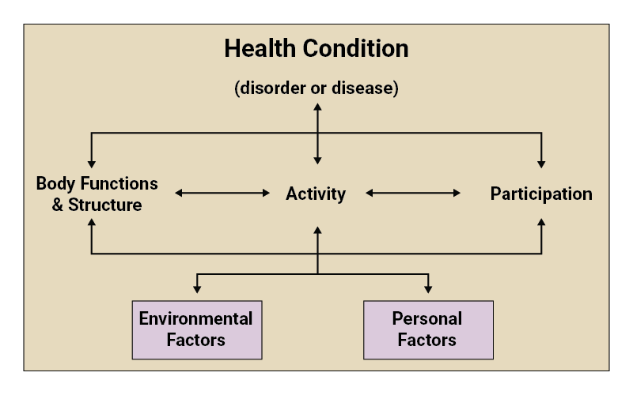
To uncover the disabling social environment, there is a need for an underlying measure of disability prevalence. To do this it is important to follow the ICF framework, which is consistent with the social model where the disability is caused by barriers in society rather than the person’s impairment. The IDS screening questions will focus on functioning in relation to basic, universal activities, such as difficulties in walking, rather than on diagnosis (medical model). Those screened into the survey will then be asked under different modules about barriers in the environment or society that may restrict their participation (social model).
Additional benefits of this approach for the Irish Disability Survey will be the availability of detailed information on functional, as well as environmental challenges. This is key to inform transport policy, design of the built environment, the design of public services and communications, supports for independent living, among other public policies. A different range of solutions may be needed to design environments and services that accommodate people with varied needs. For example, how many wheelchair spaces to provide on trains.
The screening questions will ask about the level of difficulty respondents have when completing functional activities like seeing, hearing, or walking. Asking about specific functioning leaves less room for response ambiguity; questions that are easily and consistently understood by respondents are vital for ensuring the measurement of disability is reliable and valid for national statistics.
In addition to capturing the level of functional difficulty as a disability indicator (which is in line with NDS 2006), there was strong support from stakeholders to capture level of severity as a second indicator. A measure of severity was not included in the NDS in 2006, and again there is little or no broad agreement nationally or internationally on a definition of what is meant by “disability severity”. Statistics Canada have developed a severity score in their disability survey, by combining level of functional difficulty with frequency of impact. This approach will be considered during the IDS questionnaire development phase.
The ICF model, which focuses on functional difficulties, is inclusive of people who have significant difficulty with basic functioning, but don’t consider themselves disabled or as having a disability. For example, people with debilitating health problems, chronic conditions or difficulties caused by ageing might not describe themselves as disabled but will often meet a functional threshold. Although they might not identify themselves as disabled, it is important for these people to be counted in national statistics because they too need access to funding, supports, and services.
There will be two sets of screening questions: one for children and one for adults. Respondents aged 15 and older will complete the adult version of the survey and 14 and younger will be issued the child version of the survey. These cut-offs are subject to review over the development phase. The child survey will be completed by a parent or guardian. During the questionnaire design phase, considerations will be made on how best to capture the voice of the child.
The two disability indicators, level of functional difficulty and frequency of impact will be combined to produce a severity score. A defined threshold for this severity score will need to be established during the questionnaire design phase, and ahead of the IDS pilot. This threshold will be used to identify the population at risk of disability, and to filter respondents into the other survey modules. For example, The Washington Group recommends a threshold of ‘a lot of difficulty’ or ‘cannot do at all’, when using the WG question sets.
The following functional difficulties have been proposed for inclusion in the adult screening module:
In addition to the functional difficulties listed above, several items were proposed to better capture difficulties experienced by neurodivergent people. These items were not included in the 2006 survey and will be designed and tested during the IDS pilot development phase.
Respondents will be able to report multiple difficulties, and the sequence of questions will be generally consistent across all assessed functional difficulties. For example, questions for seeing difficulties may reflect the following:
This pattern of questions will be repeated for each functional difficulty. The combination of questions on level of functional difficulty and frequency of impact will facilitate a severity score being established. We will review and utilise methodology established by Statistics Canada, which derives a severity score based on functional difficulty and the frequency of impact on daily activities. Establishing a level of severity would not be possible by asking level of functional difficulty alone, as was done in NDS 2006.
The following child disability screening sets were informed by Stats New Zealand and the WG Child Functioning Module. Parents or guardians of respondents below the age of 14, will be invited to participate on behalf of the child. As with adults, the screening questions for children focus on the respondent’s ability to carry out specified activities or their functional difficulties. Functioning tends to improve with age, so the child questionnaire will have three variations of the screening questions to suit the child’s expected stage of development based on their age. There is no limit on how many functional difficulties a child can screen in on.
The following functional difficulties have been proposed for inclusion in the child screening module, for children younger than two:
The following functional difficulties have been proposed for inclusion in the child screening module, for children aged 2 to 4 years old:
Children aged 5-14 years old will be considered disabled if they have a lot of difficulty with, or cannot do, any of the following:
During stakeholder consultation, information on diagnosed Autism and diagnosed ADHD was identified as a data requirement. A decision on whether diagnosis will be incorporated into the disability threshold (based primarily on level of functional difficulty) will be reviewed during the design phase. If undiagnosed, self-identified Autism and ADHD will also be collected.
Other topics that will be captured within the screening module but will not be factored into the threshold to identify the population at risk of disability include:
Any remaining topics suggested by stakeholders during the consultation phase, but considered out of scope for the pilot, are detailed in the next section.
There was a lot of interest to capture detail on various functional difficulties and behavioural differences. A balance is needed here to ensure the screening module doesn’t become overly burdensome. Considerations were made towards which topics align to international comparators, and topics that were too specific to provide meaningful data. Internal sensory difficulties, for example difficulty with balance and movement, body position and force, or internal body signals, such as hunger signals, were deprioritised based on stakeholder recommendations.
During the consultation process there was some interest to collect information on written or oral communication difficulties, and sleep difficulties. It was agreed that these topics largely overlap or are related to some in-scope-topics detailed above. Detail on difficulties with specific daily tasks beyond personal care, and difficulties adapting to new environments were deprioritised from the screening module but some information on these topics will be collected elsewhere in the survey.
The consultation revealed some interest in learning more about disability status and how people identify with certain labels or conditions. There were suggestions to capture detail on disability status categorised as acquired, progressive, intermittent, idiopathic, or congenital. There was also a suggestion to collect specific detail on long-term illnesses, health problems or conditions, as classified under the ICD-11 framework. There was a suggestion to ask respondents if they identify as ‘neurodivergent’ and if formally diagnosed, whether the neurodivergent diagnosis was received through a public or private process. There was some interest in medication usage, but this ranked lower than other topics retained for inclusion.